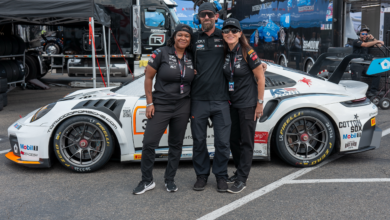
Behind The Scenes At Petit Le Mans: How Tech Powers Atlanta’s Premier Race
It’s October 2nd, 2026. One day before the premiere race in Georgia’s largest international motorsports event, the Motul Petit Le Mans. Tomorrow, upwards of 150,000 people will descend on Michelin Raceway Road Atlanta to watch 10 hours of racing. In the background IMSA GTD Pro qualifying roars around Road Atlanta.
For this Motul Petit Le Mans, I have the opportunity to do something a little different. To see a side of the race most fans probably don’t even think about. What does it really take to power professional racing at this scale from a technology standpoint? And how will technology shape the future of the sport?

As a lifelong technologist, my interest in this topic may be stronger than most. But let’s be honest: the Venn diagram of people who are into technology and motorsports has a lot of overlap. Of course, I’m also an amateur race car driver. And even on top of all of that, my day job brings me to the racetrack as many as 3 of 4 weekends a month. Roll in my experience as the owner of a Digital Marketing Agency and a career in Fortune 500 consulting where I helped manage equipment in data centers for some of the world’s largest companies, I couldn’t miss the opportunity to learn more about what kind of technology powers races of this scale.
On this beautiful Friday, I take a break from my business responsibilities, and my desire to watch motorsports as an enthusiast to spend time somewhere most fans never get to look: inside the trailers, server racks, and monitor walls that let IMSA run a ten-hour, four-class race.
The short version is that an IMSA race no longer happens without its technology. Timing, officiating, team engineering and the TV broadcast all run through a mobile data center parked in the paddock. If that trailer goes dark, the race effectively stops being a race and becomes a group of very expensive cars driving in circles with nobody keeping score or managing what is ultimately organized chaos.
It Starts With Technology You May Have Used Before
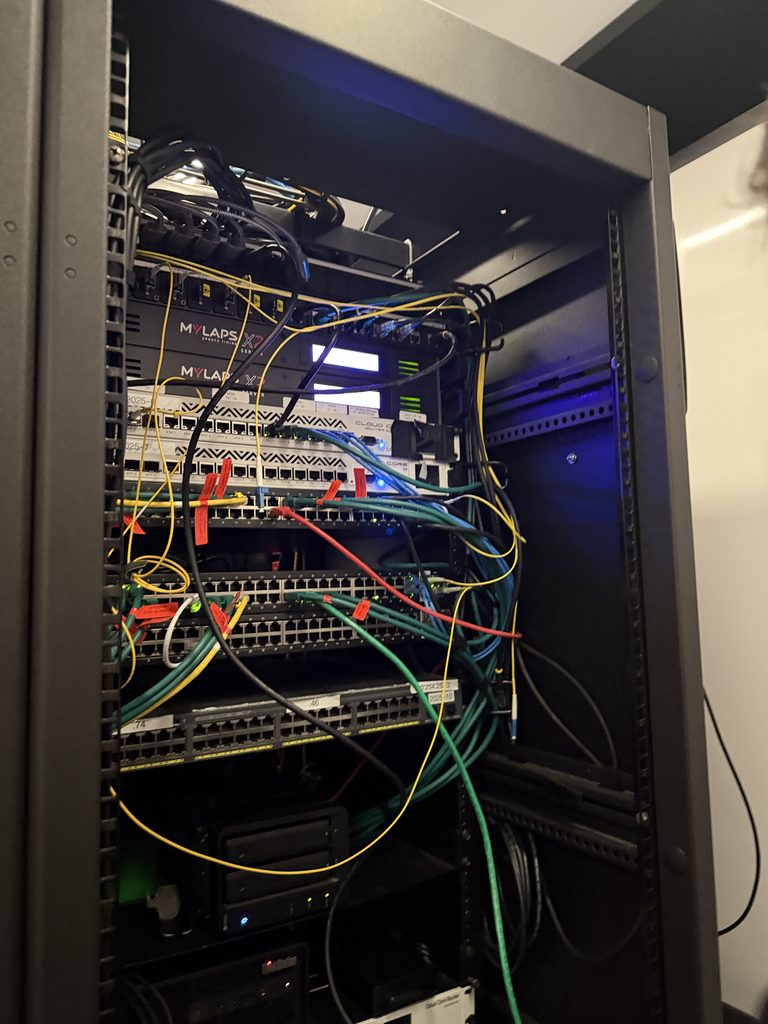
Everything at an IMSA race begins with a box most grassroots or club racers already own. Any car that has competed in a club race, sprint, endurance race or time trial probably carried a MYLAPS transponder. Yep, the same family of hardware that SCCA, NASA, karting clubs and local time trials rely on. If you’ve ever zip-tied a rechargeable TR2 to a bracket someone in your car or panicked when your name didn’t show up on the timing screen after first practice, you already know the core of IMSA scoring.
The principle hasn’t changed. Each transponder broadcasts a unique ID. A wire loop cut into the track surface picks up that signal as the car crosses it, and a decoder at the other end of the cable stamps the crossing with a precise time. At a club weekend there might be one loop at start-finish and maybe one at pit-in. IMSA puts 15 or more loops around each circuit, and every crossing captures more than 100 pieces of data per car, at speeds over 200 mph. That turns a lap time into sector times, speed traps, pit lane entry and exit, and pit stop durations for every car on the grid.
The raw MYLAPS passings then feed Al Kamel Systems software, IMSA’s timing and scoring partner since 2016. Al Kamel turns the passings into the running order, gaps, class positions and reports that race control, the teams, the broadcast and the live timing on IMSA.com all depend on. In a multi-class field that matters enormously. A GTP car lapping a GTD car isn’t a position change for either of them, and the software has to know that instantly for four classes at once.
During the tour of the data center, we heard a story about a safety car’s transponder not working. They used on on hand 3D printer to recreate a mount to adjust the positioning. Most grassroots racers have had to do an emergency move of their transponder due to an issue. With IMSA, race control needs to know exactly where the safety car is while it’s managing a 50-plus-car field under caution, so it gets fixed right away. It was oddly reassuring to learn that the pros chase transponder gremlins too.
Race Control: Organization From Chaos
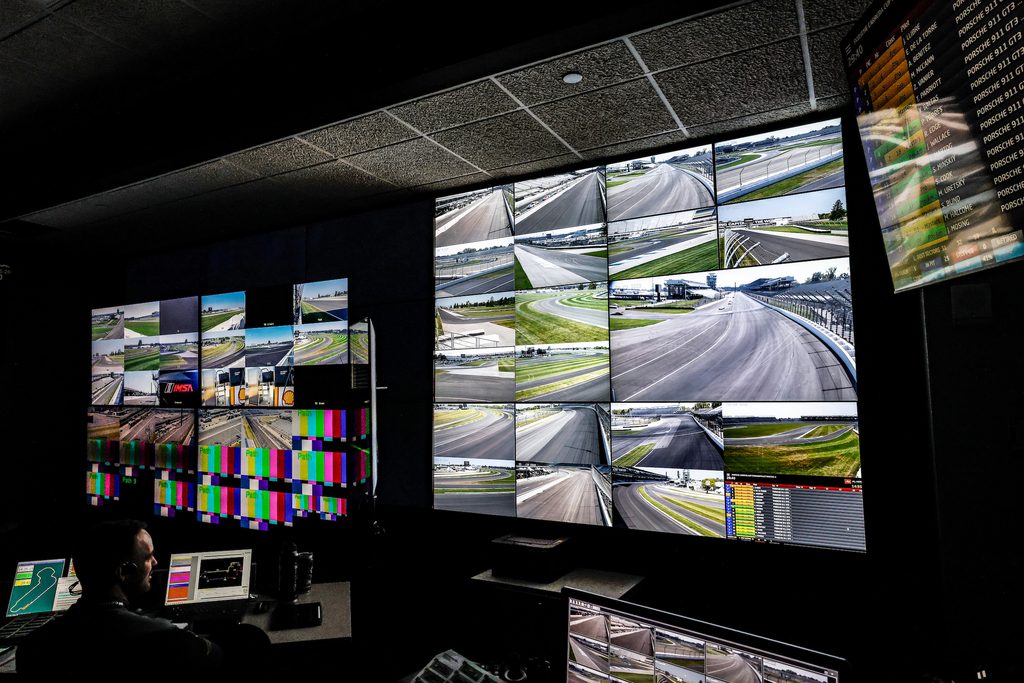
IMSA Race Control – Image Courtesy of IMSA/Lumen Digital Agency
Old-timers remember when race control was a room full of radios. Until the early 1980s, IMSA officiated with corner workers who called incidents in by two-way radio, and there was no video at all. Even a few years ago, officials largely depended on whatever the TV cameras happened to be pointed at, and reviewing an incident was slow.
That changed when IMSA moved to Catapult’s officiating software (formerly SBG Sports Software). It combines HD video, MYLAPS and Al Kamel timing data, and car telemetry into one time-stamped package. On a race weekend, IMSA can run up to 72 camera angles, from more than 50 cameras around the circuit. When a steward pulls up a replay of contact in Turn 10, the video lines up with each car’s position, speed and inputs at that moment.
This is done on site in a small control room on the 4th floor of the Michelin Tower, just down the hall from where the Drivers Club of Road Atlanta room is. The control room is powered by about a dozen Lenovo ThinkPad Z16 laptops with AMD Ryzen CPUs and Radeon graphics. Catapult is demanding on both CPU and GPU, and each laptop may have dozens of camera angles open at once. IMSA multicasts the video across its own network, so five or six officials in race control can each follow something different: pit lane, a technical issue, or a damaged car that someone needs to watch lap after lap to see if it’s getting worse. Other people can watch the same feeds from pit road or the scrutineering center. IMSA’s competition staff say that running several of those views in parallel has made decisions quicker and safer.
Race control also watches the infrastructure. One wall in the operations space tracks every piece of temporary equipment IMSA installs around the track: every network switch, the voltage of every battery powering them, and every IP camera. If a camera at the back of the circuit drops because its battery is running down, someone sees it before a steward goes looking for that angle and finds a black square.
Race Engineering: Every Detail Matters
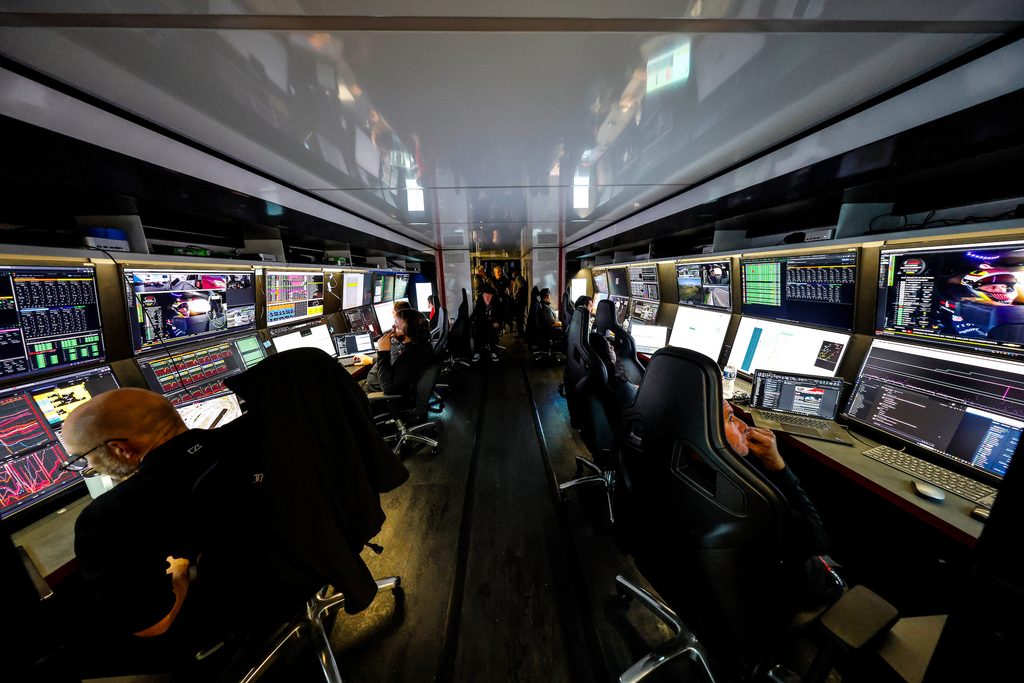
IMSA Race Engineering – Image Courtesy of IMSA/Lumen Digital Agency
In my own car, data means a lap timer and maybe a few channels from an AiM logger I look at on Sunday night. IMSA’s engineering group deals with upwards of 400 channels per car, many logged at one-millisecond intervals, from a field that can top 50 cars. The hybrid GTP prototypes alone carry 178 real-time sensors. Across the 2025 season, IMSA estimates it captured at least 40 TB of data.
Much of that comes through a Bosch data logger fitted to the cars, built around AMD FPGAs that handle the time-critical processing in the car. IMSA uses it for scrutineering and for balance of performance, which is how the series keeps a Corvette, a Porsche, a BMW and a Ferrari racing each other on equal terms in the same class. IMSA’s engineers analyze it on the same Lenovo laptops in real time, and the series says performance reports are ready as soon as the checkered flag falls.
Safety benefits too. When a car hits the wall, IMSA knows how big the impact was from the data before the safety crew arrives. That’s a long way from waiting for a corner worker’s radio call.
The Lenovo folks on the tour framed the track as a proving ground. IMSA’s leadership points out that 18 automakers race in the series partly because what they learn carries over to road cars. GM engineers take hybrid deployment strategies from GTP races back to their tech center in Concord and to Michigan. Michelin keeps every tire the teams use and cuts them up to study compound and construction. Lenovo sees its own hardware the same way. A server that survives a season in a trailer is a good candidate for the back of a retail store or a distribution center running at 120°F with no proper data center around it. They mentioned Cleaver-Brooks, an Atlanta-area boiler manufacturer that uses the same class of Lenovo workstations as race control, and says it cut engineering and render time roughly in half.
In addition, IMSA’s software development teams are already leveraging AI to build applications that allow them to display all of the race engineering data in new ways without long and complicated development cycles. The ability to watch fuel burn down across cars on screen without pulling their valuable resources away from more critical tasks.
Real World Impacts Of Data For Drivers And Teams
If you’ve ever wondered how a Porsche 963, a BMW M Hybrid V8, a Cadillac, an Acura and a V12 Aston Martin Valkyrie can finish ten hours separated by seconds, the answer is Balance of Performance (BoP). Modern BoP is a data problem first and a rulebook problem second.
BoP used to be blunter. Before 2016, IMSA’s GT calculations used only timing and scoring data, which was easy to game by sandbagging. That year IMSA made Bosch data loggers mandatory, capturing RPM, throttle position and airbox pressure, so officials could see whether a car was being driven flat out or held back.
Today the key sensor is the torque sensor. In GTP, IMSA and the FIA use collars on the LMDh cars’ halfshafts to measure power and energy output. The series expanded this in 2025: for the first time, magneto-elastic torque sensors became mandatory on the GT3 cars in GTD and GTD Pro. They monitor powertrain data in real time, and IMSA can penalize teams that exceed their powertrain limits.
Live scrutineering, not just post-race review. Torque sensor data from the rear driveshafts has to reach IMSA in real time every time a car is on track. Bosch checks that every sensor is working and calibrated during scrutineering, which happens several times over a weekend. All of this feeds the same race-control infrastructure described above. IMSA’s telemetry, timing and scoring data go into a MongoDB database on the Lenovo ThinkSystem SR645 V3 servers in the trackside truck. The data is clearly part of the officiating process, but the public sources don’t say exactly which BoP calculations run on which hardware.
The BoP bulletins can read like a spec sheet, and every number in them can be checked against data. Here’s an example of what can and has been changed:
- Minimum weight: for example, 1,045 kg for the Acura ARX-06 and 1,066 kg for the Porsche 963
- Two-stage power: a percentage of maximum power below a speed threshold (V1, 230 km/h in GTP) and another above V2 (240 km/h)
- Maximum stint energy: a cap in megajoules on how much energy a car can use between stops (for example, 907 MJ for the Porsche)
- Energy replenishment rate: how fast that energy allowance refills during a stop
- GT3 rear wing angle: a minimum and maximum range for GT3 cars
The two-stage power system is the clever part. It allows IMSA to tune for different strengths, such as how well a car puts power down out of a slow corner versus its aero efficiency. The aim is to equalize not just lap time but how each car gets to it. That’s particularly important at a place like Road Atlanta, where the long back straight and the esses reward very different car traits.
When the final restart comes down to energy management, that’s BoP in action. Each GTP car started its last stint with a fixed energy allowance in megajoules, and the drivers had to decide how much to deploy for attack and defense against how much to save to reach the flag. Vanthoor holding off van der Linde and Blomqvist was as much a battle of energy budgets as of bravery.
One interesting net about Balance Of Power is that is doesn’t apply in LMP2. Every car is a spec ORECA 07-Gibson, so the 0.666-second finish between CrowdStrike and Inter Europol came down purely to driving, pit work and strategy.
A Mobile Data Center
“…the most punishing environment possible.”
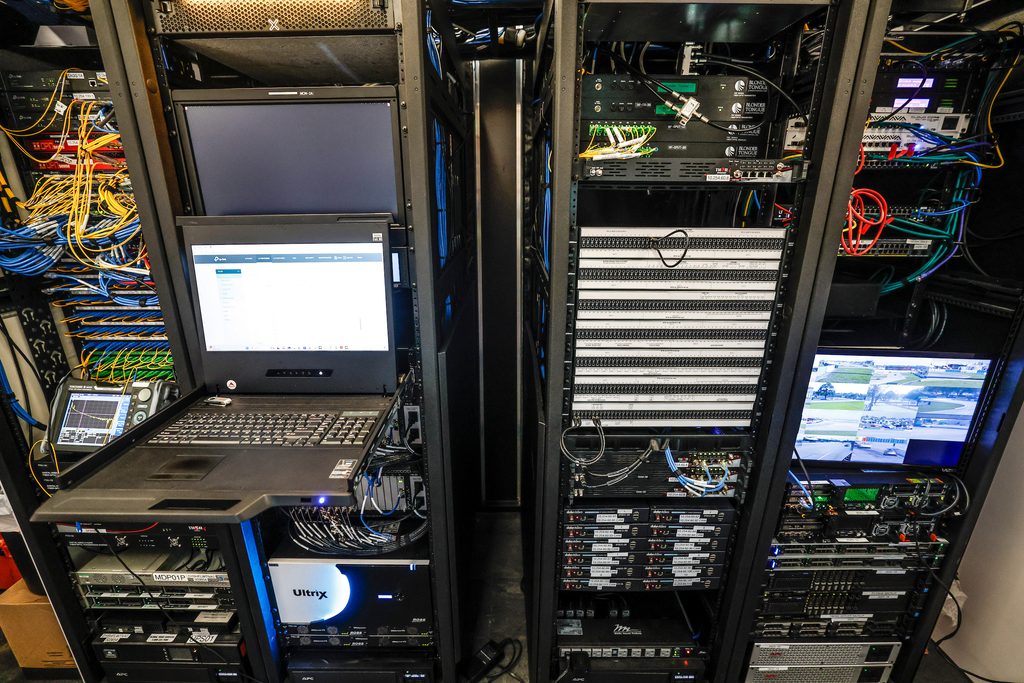
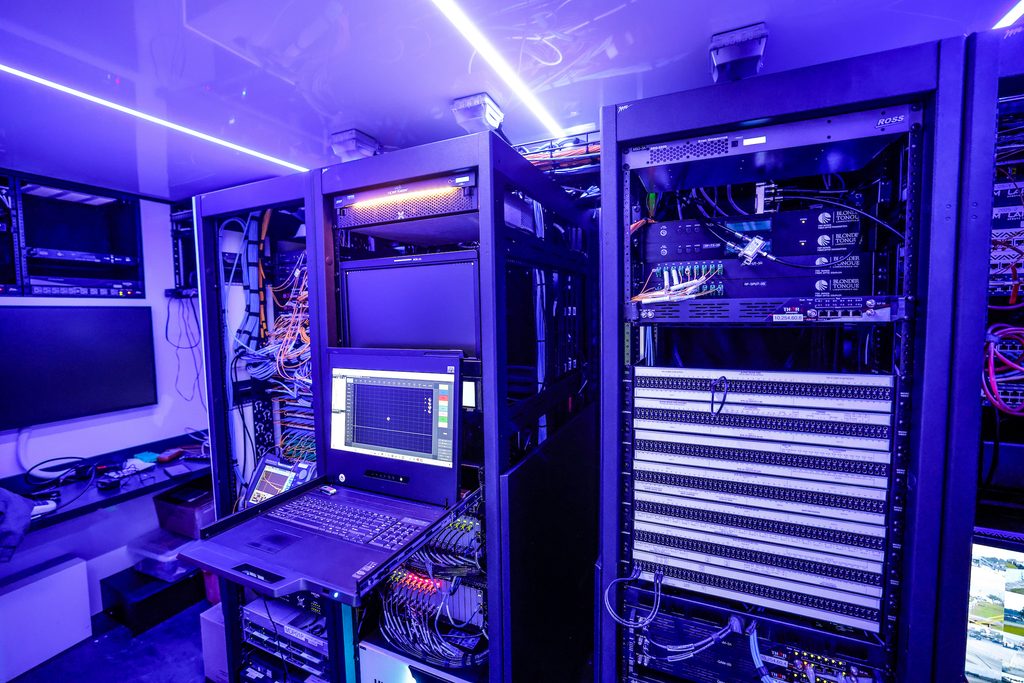
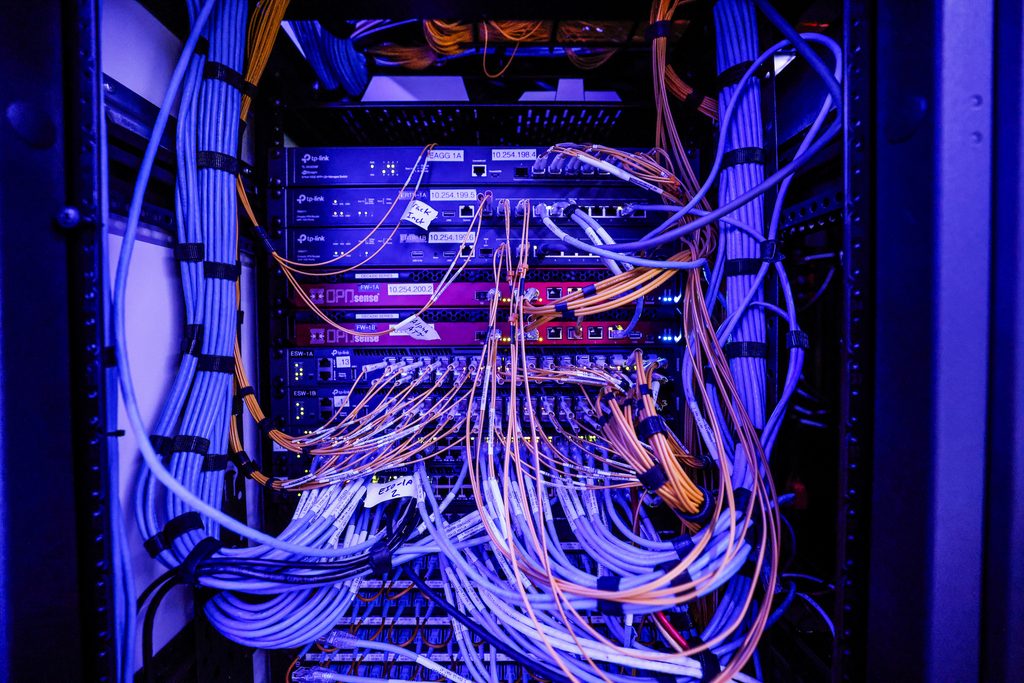
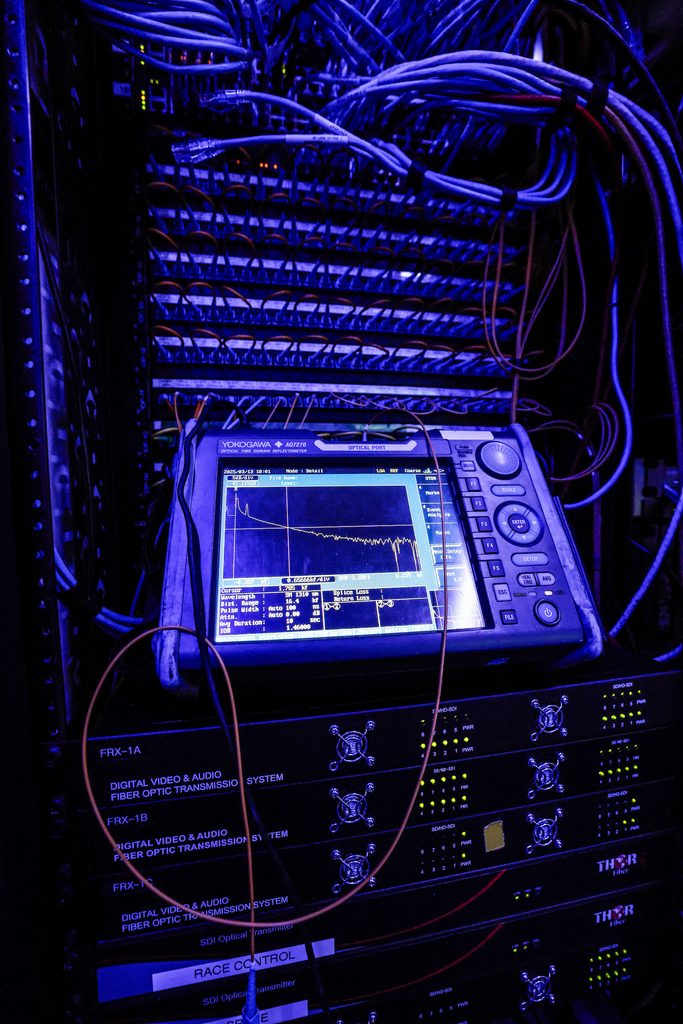
Lenovo Tech Center – Images Courtesy of IMSA/Lumen Digital Agency
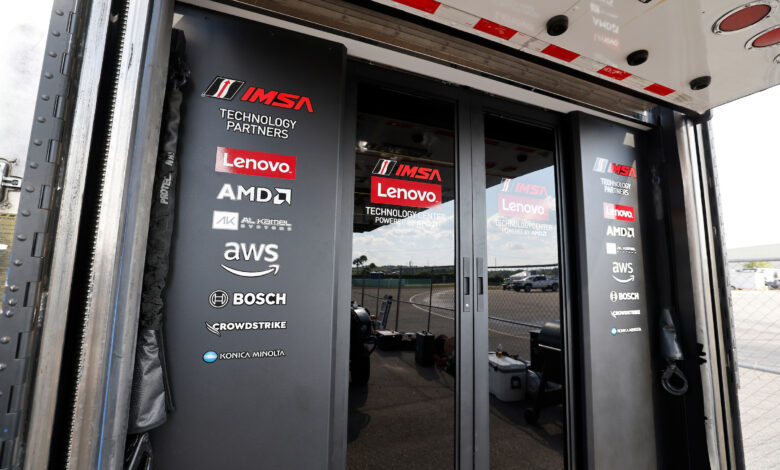
All of this runs out of the IMSA Lenovo Technology Center Powered by AMD, a tractor-trailer that debuted at the 2025 Rolex 24 and now goes to every WeatherTech Championship round. The team was candid that it isn’t a Tier III data center and isn’t trying to be one. It’s a server room that covers more than 20,000 miles a year, roughly a lap of the planet, through heat, humidity, rain and road vibration, and it has to work the moment it’s powered up at the next track.
“We take that mobile data center, it goes over 20,000 miles every year, and it’s basically a lap around the earth every year.”– Robert Daigle, Lenovo
Power is the first line of defense, and it’s triple redundant. The trailer shares a large generator with the paddock compound, it carries its own onboard generator, and it has a battery backup system with UPS units to bridge any switchover. Between those layers, they’re confident they can ride out almost anything a race weekend throws at them.
“We take that same server that we’re using and testing in one of the harshest environments here and we gotta drop that into a distribution center down the road.” – Robert Daigle, Lenovo
The compute side is deliberately simple. The core is a pair of Lenovo ThinkSystem SR645 V3 servers with AMD EPYC 7313 16-core processors, 128 GB of RAM and 15 TB of solid-state storage each. One is primary and the other is the backup. Catapult writes video to disk at around 700 MB per second while timing, scoring and telemetry stream into a MongoDB database. IMSA says the servers barely get past 60 percent utilization, which is the kind of headroom you want when there are no second chances. The newer piece is Lenovo ThinkEdge SE455 V3 edge servers, which IMSA planned to use to move off VMware and onto Microsoft Azure Local.
What struck me was the philosophy. The team told me plainly that they avoid complicated high-availability clustering, and that’s on purpose. On a race weekend, a straightforward main-and-backup setup is easier to understand, troubleshoot and fail over under pressure than an elaborate cluster. As someone who has repaired a car in the paddock between sessions, I appreciated that. Simple systems are easier to fix when it counts.
Monitoring is constant. One screen shows nothing but the server’s status, with CPU load watched closely because video is the heaviest workload. The network extends out of the trailer over more than 10 miles of fiber for timing and scoring, race control and trackside internet for the teams, which also lets factory engineers support their cars remotely. Because the timing loops, cameras and fan-facing data all depend on it, nobody needs to explain what’s at stake. If the trailer goes down, everyone at the track and watching on TV will notice.
How It All Winds Up On Your TV
“Without the Lenovo tech truck sending that feed, like, the broadcast doesn’t happen.”
Most of the broadcast isn’t produced at the track anymore. When Petit Le Mans aired on Peacock (with portions on NBC), the people at Road Atlanta were mostly the pit lane reporters, a few camera operators and the crews running the trackside cameras. The production itself happened in Concord, North Carolina, where 30 to 35 people work in a room with about 100 screens. Some of them do nothing but pull timing and telemetry feeds onto the screen.
Those feeds come from the Lenovo trailer. IMSA put it simply on the tour: without the tech truck sending data to Concord, there is no broadcast. The running order, gaps, class battles, and on-screen telemetry graphics showing throttle, braking, speed and remaining energy for the hybrids all start as MYLAPS passings and car data in the paddock. The same data drives a live telemetry page on IMSA.com.
IMSA is also building a large audience outside traditional TV. The series told us its YouTube channel had just reached 2 million subscribers, putting it about even with NASCAR in the U.S. among motorsports channels. When IMSA streamed Sebring live, flag to flag, outside the U.S. at no cost and with no promotion, it drew a global audience in the hundreds of thousands. Its behind-the-scenes documentary episodes, including one with unfiltered radio from a Penske team-orders dispute at Sebring, are averaging millions of views. Social following is up about 30 percent over two years.
Where Technology May Take The Fan Experience Next
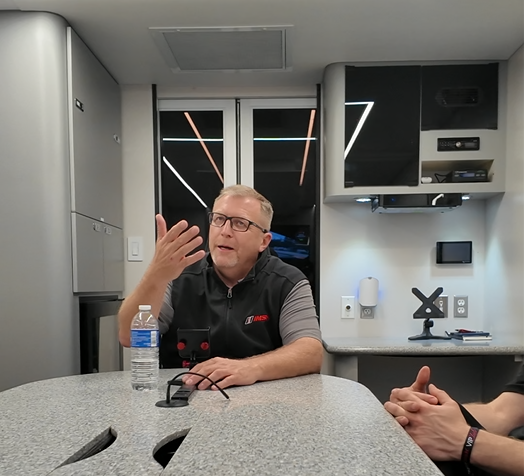
The best part of the day was sitting and listening to John Doonan, President of IMSA, describe how technology could impact the fan experience in the future. And just as insightful, how an IMSA weekend is a lab. It’s a lab for the manufacturers, it’s a lab for the team, and it’s a lab for the organization to develop the future of the fan experience.
“So for me, it’s a lab, it’s always been a lab, and that’s the part of it that, as a kid, got me so excited.” – John Doonan, President of IMSA
When he was a kid, the big upgrade was renting a scanner to listen to team radio. He wants the next version to be an opportunity for fans to experience full live telemetry for any car you choose: hybrid deployment, fuel, steering, brake, and throttle, without exposing teams’ proprietary data.
Lenovo team also discussed AI in the same spirit. Imagine a fan asking an on-site assistant how the Corvette took the lead and hearing that it took only two tires on the last stop and gained track position in the pits. Or for someone new to multi-class racing, it could answer questions like: how are four races happening at once?
There is also talk in the future of being able to tie in things like biometric data from FIA-approved monitoring systems, which could show fatigue setting in late in a ten-hour race. Of course, part of rolling out AI and consuming data is that not everything is a user experience question. For example, with health data, are there privacy rules it must consider?